Specialized web shop for swimming pools, hot tubs and saunas
02. March 2026.
Maintenance starts from the pool surface
When planning a pool, most people first think about the shape, size, and color of the water, and only then about what will actually keep that water in perfect condition day in and day out. However, the surface of the pool directly affects how long it will take to clean, how often deposits will appear, and how hard the chemical system will have to “work” to keep the water clear.
The most common dilemma is the classic one: pool liner or ceramic tiles. Both options may look luxurious, but they differ in their behavior in practice — especially when typical challenges such as limescale, greasy edges, and algae build-up start to appear after a few months.
Ceramic tiles: long life, but more “minor work”
Ceramic is an attractive choice because it feels durable, sturdy, and “premium.” A well-executed tile covering can last for years, but maintenance often becomes more demanding precisely because of the details you don't see at first.
Joints as a critical maintenance point
With a tiled pool, most of the cleaning is actually not about the tile itself, but about the joints. They are more porous than ceramics, retain dirt more easily and can become a place where algae and microorganisms are more easily taken in, especially if water disinfection occasionally "fails" or if the circulation is not ideally adjusted.
Limescale and the “waterline”
Limescale can be visible on ceramic tiles, but it is often more stubborn in the grout area. The waterline (the area where water meets air) requires more regular wiping because it is where sunscreen oils and dust accumulate, and rougher areas or the microstructure of the grout can further exacerbate this.
The advantage of ceramics
The advantage is that ceramics are generally resistant to wear and mechanical damage, so with quality waterproofing and properly executed concrete, it can be a stable solution. However, waterproofing, adhesives and grout are precisely the part of the system that must be implemented without compromise — otherwise maintenance becomes more expensive and complex over time.
Pool liner: easier cleaning and waterproofing control
With pool liners, the logic is different: the liner is both a finishing coating and waterproofing, so a lot of the risk comes down to fewer “layers” in the system. In practice, this often means fewer places where dirt can accumulate.
Less connections, less problems
The high-quality reinforced foil is welded at the joints, resulting in a continuous, waterproof surface with minimal “hot spots.” This is important for daily maintenance because robot cleaners and manual brushing provide a more even surface, without joints that require extra attention.
Faster and more predictable maintenance
The liner is typically more convenient for routine cleaning: there are fewer “micro-pockets” where fine particles can be trapped, and most of the dirt remains on the surface and is easier to remove by filtration, vacuuming, or robotic cleaning. The result is that maintenance time is often reduced, and the cleaning schedule is more consistent over the week, month, and season — especially with a good pool maintenance plan.
Renolit Alkorplan Touch 2 mm: a foil that looks like a natural material and is maintained like a foil
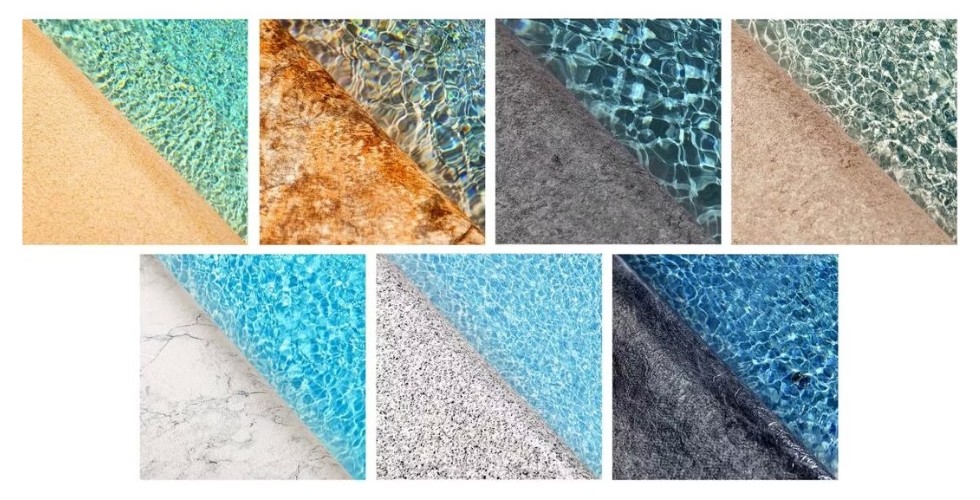
If you are looking for a foil that does not look “plastic”, RENOLIT ALKORPLAN TOUCH is in practice one of the most interesting choices because it combines a luxurious feel and functionality. It is a 2 mm thick reinforced PVC membrane with a recognizable 3D relief structure that visually and tactilely imitates natural patterns such as stone or slate.
Key data and what it means in maintenance
- 2 mm thickness: greater thickness generally means greater wear resistance and a more stable feel underfoot, especially on steps and in shallow water.
- Reinforced construction: the foil is reinforced and designed to maintain watertightness even when the structure is subjected to minor stresses over time.
- 3D relief and natural finish: a “ceramic/stone” effect is obtained without joints, which simplifies cleaning compared to ceramic tiles.
- Resistance to UV and pool chemicals: a more stable color and surface over time make it easier to maintain aesthetics, especially in an outdoor pool.
- Anti-slip surface: useful in areas with the most foot traffic (steps, shallow area), and in practice reduces the need for “improvisations” such as additional strips or rough coatings.
The TOUCH line comes in several designs (e.g. Elegance, Prestige, Relax, Authentic and others), which allows the appearance of the water and space to be adapted to the architecture, without switching to ceramic tiles.
What is actually easier to maintain?
If the primary criterion is daily and weekly cleaning, pool liner usually has the advantage because it offers a more even surface and fewer places for dirt to accumulate. With tiles, maintenance is more often “stretched out” into several smaller interventions, especially around the joints and waterline.
On the other side, tiles have their audience due to their perceived durability and specific aesthetics, but this choice makes sense when the entire system (concrete, waterproofing, adhesives, grouting and details) is top-notch and when a little more time is expected for care.
In practice, for owners who want their pool to look sophisticated and for maintenance to be rational throughout the day, month and year, Renolit Alkorplan Touch 2 mm is a solution that combines the visual effect of natural materials with the advantages of foil: faster cleaning, easier surface control and longer-term stability of appearance in real conditions of use - especially when the pool is designed as a quality solution such as concrete pools with appropriate pool equipment.
Read more and…